Chainlink Workflow
The Autonomous Hedge Fund System
Apollos Finance is not a static DeFi protocol that waits for user interaction.
With Chainlink CRE (Chainlink Runtime Environment), Apollos operates as a 24/7 autonomous system with seven parallel workflows designed to:
- Protect LPs from real-time market risk.
- Keep leveraged positions healthy.
- Verify credit-source solvency.
- Compute and publish NAV efficiently.
- Optimize cross-chain deposits.
- Publish transparent machine decisions through AI logs.
- Compute and publish VaR risk feeds for each vault.
This architecture functions as the Central Nervous System of Apollos.
Workflow Map
- The Reactive Defender
- The Strategist
- The Solvency Auditor
- The Accountant
- The Cross-Chain Manager
- The Reporter
- The VaR Calculator
Template Mapping
- Defender
Template: building-blocks/indexer-block-trigger - Strategist
Template: starter-templates/custom-data-feed/cre-custom-data-feed-ts - Auditor
Template: starter-templates/custom-data-feed/cre-custom-data-feed-ts - Accountant (NAV)
Template: starter-templates/bring-your-own-data/workflow-ts/nav - Cross-Chain Manager
Template: starter-templates/multi-chain-token-manager - Reporter
Template: starter-templates/tokenized-asset-servicing - VaR Calculator (Hybrid)
Primary: starter-templates/bring-your-own-data/workflow-ts/nav
Secondary: building-blocks/read-data-feeds
1) The Reactive Defender
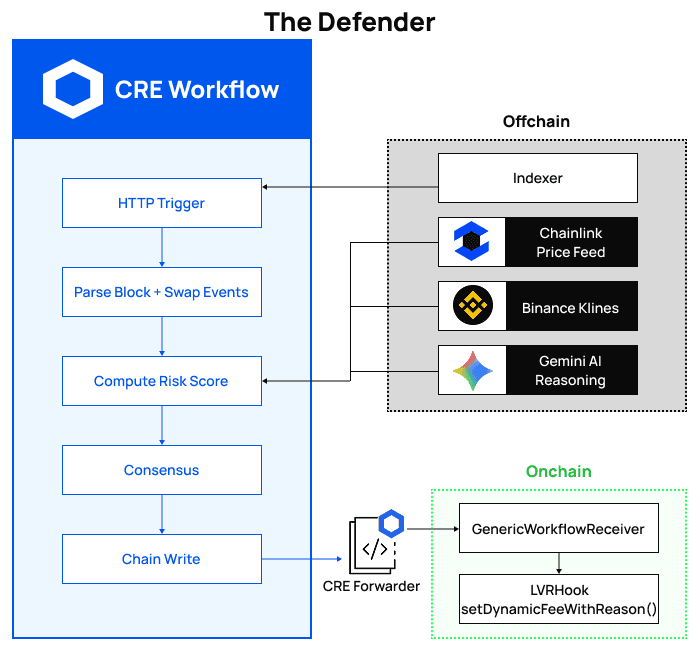
Core feature: Event-driven LVR protection and anti-JIT defense
Template: building-blocks/indexer-block-trigger
Problem
Arbitrage bots can attack pools within seconds during volatility spikes, reducing LP profit through LVR loss.
How It Works
- Listen: receive indexer payload through HTTP trigger.
- Detect: parse swaps and identify whale activity.
- Analyze: combine Chainlink/Uniswap divergence, optional Binance volatility, and optional Gemini vote.
- Consensus: aggregate signals.
- Chainwrite: send
writeReportthrough CRE Forwarder and GenericWorkflowReceiver to updateLVRHook.setDynamicFeeWithReason(...).
Value
Fast, event-driven LP protection without waiting for long cron intervals.
2) The Strategist
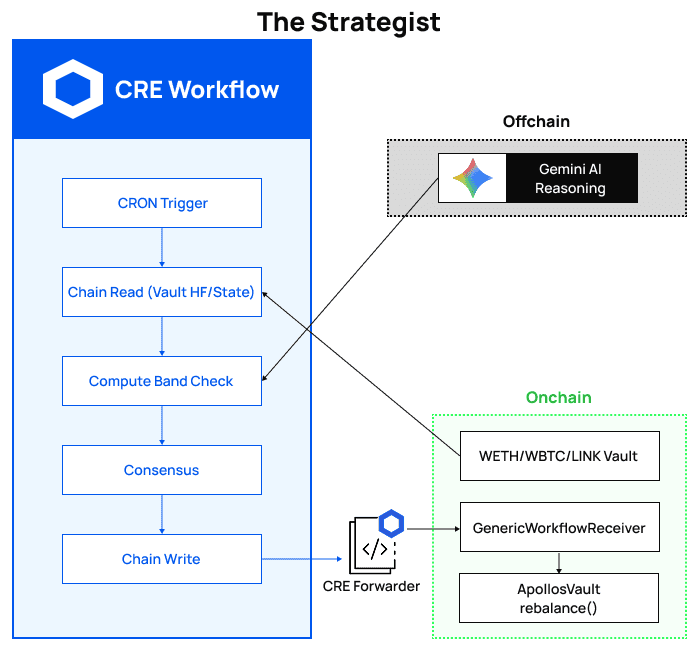
Core feature: Health Factor rebalancing and yield optimization
Template: starter-templates/custom-data-feed/cre-custom-data-feed-ts
Problem
If collateral drops sharply, the position risks liquidation. If too safe, capital becomes underutilized.
How It Works
- Monitor: cron runs every configured interval to read
getHealthFactor()per vault. - Compute: compare HF against configured band (
hfMin,hfMax). - Decision:
HF < hfMin-> defensive rebalance.HF > hfMax-> capital-efficiency rebalance.
- Chainwrite: trigger
rebalance()viawriteReportpath (Forwarder -> GenericWorkflowReceiver -> Vault). - Optional AI: attach Gemini reason log for operator visibility.
Value
Set-and-forget operation: positions are managed automatically 24/7.
3) The Solvency Auditor
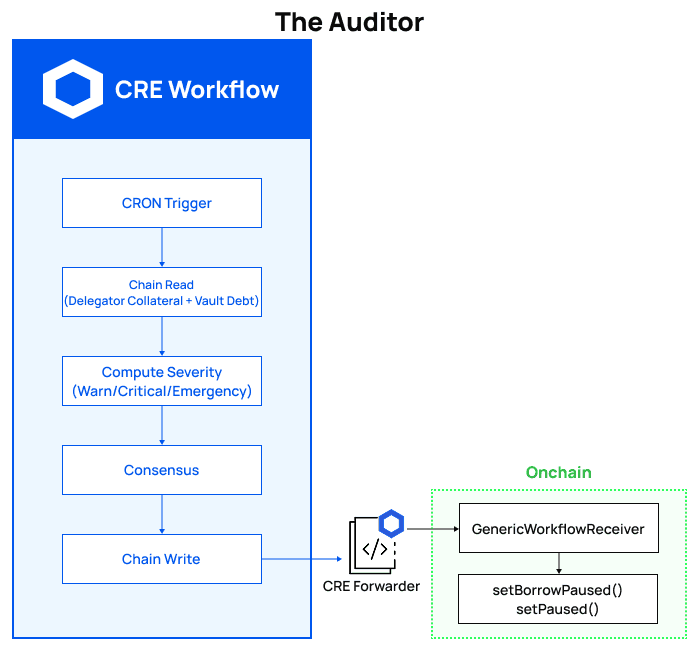
Core feature: Lender-liquidity verification (whale monitoring)
Template: starter-templates/custom-data-feed/cre-custom-data-feed-ts
Problem
If a delegator/whale suddenly withdraws liquidity, vault credit capacity can collapse and create repayment risk.
How It Works
- Check: cron reads delegator collateral and vault debt from Aave state.
- Verify: compute collateral/debt ratio in bps.
- Classify severity:
OKWARNCRITICALEMERGENCY
- Chainwrite:
WARN/CRITICAL->setBorrowPaused(true)when needed.EMERGENCY->setPaused(true)when configured.
- Optional offchain alert: POST emergency payload to reporter backend.
Value
Prevents systemic failure from credit-line dependency.
4) The Accountant
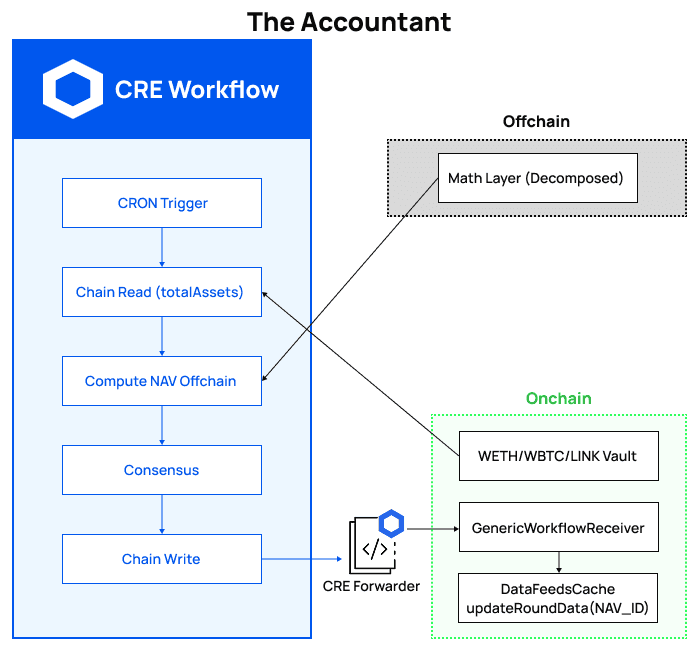
Core feature: Off-chain NAV/share-price computation and feed publication
Template: starter-templates/bring-your-own-data/workflow-ts/nav
Problem
Full NAV computation in Solidity is expensive for user deposit/withdraw transactions.
How It Works
- Collect: read vault state (
totalAssets) and optional decomposed sources. - Compute off-chain:
- fast mode:
totalAssets. - decomposed mode:
NAV = (Idle + LP Value) - Debt.
- fast mode:
- Consensus on computed NAV.
- Chainwrite publish:
- Forwarder -> GenericWorkflowReceiver ->
DataFeedsCache.updateRoundData(dataId, answer, updatedAt).
- Forwarder -> GenericWorkflowReceiver ->
- Consumer integration:
- Vault/oracle readers consume NAV through
latestRoundData(bytes32 dataId).
- Vault/oracle readers consume NAV through
Value
Significant gas savings for users and stronger Chainlink-native design.
5) The Cross-Chain Manager (Bridge Optimizer)
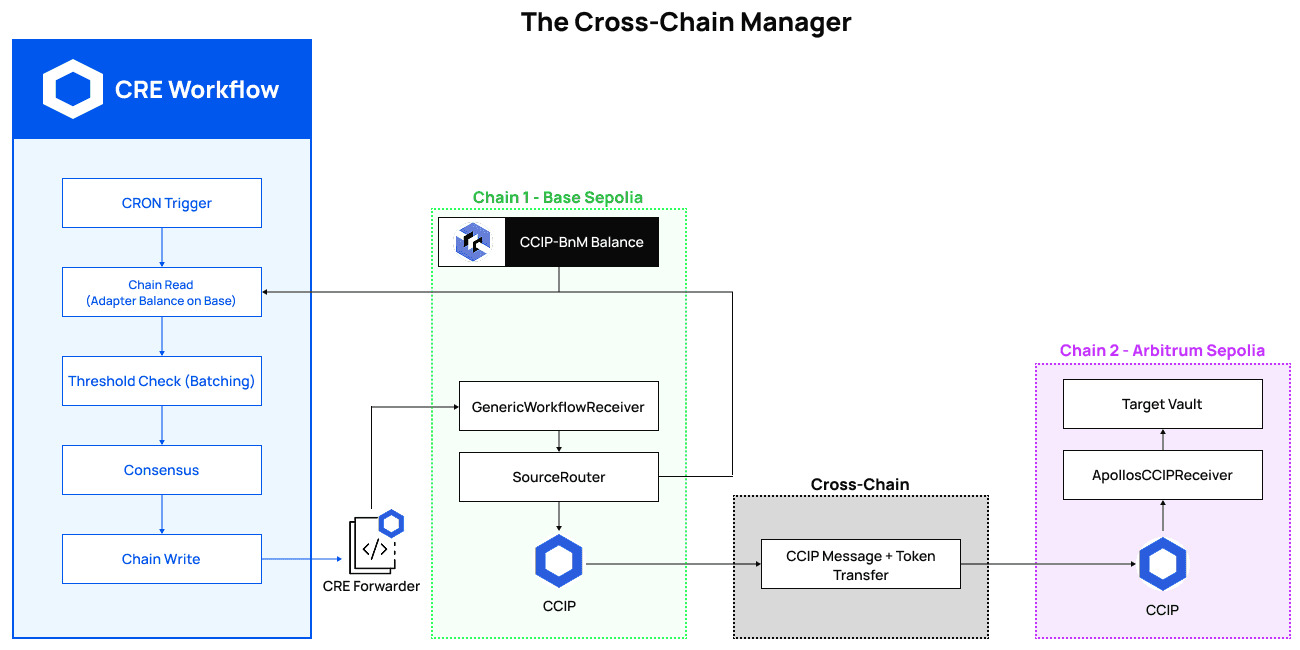
Core feature: Cross-chain deposit aggregation (batching)
Template: starter-templates/multi-chain-token-manager
Problem
Bridging every small deposit through CCIP is cost-inefficient.
How It Works
- Buffer: keep deposits in source-chain adapter/router.
- Monitor: cron reads adapter token balance.
- Threshold policy: if balance >=
batchThreshold, execute bridge. - Chainwrite path:
- Forwarder (source chain) -> GenericWorkflowReceiver ->
SourceRouter.bridgeToArbitrum(...).
- Forwarder (source chain) -> GenericWorkflowReceiver ->
- CCIP delivery:
- message and token transfer reach receiver on destination chain.
Value
Substantially lower bridge cost for retail users through batching.
6) The Reporter
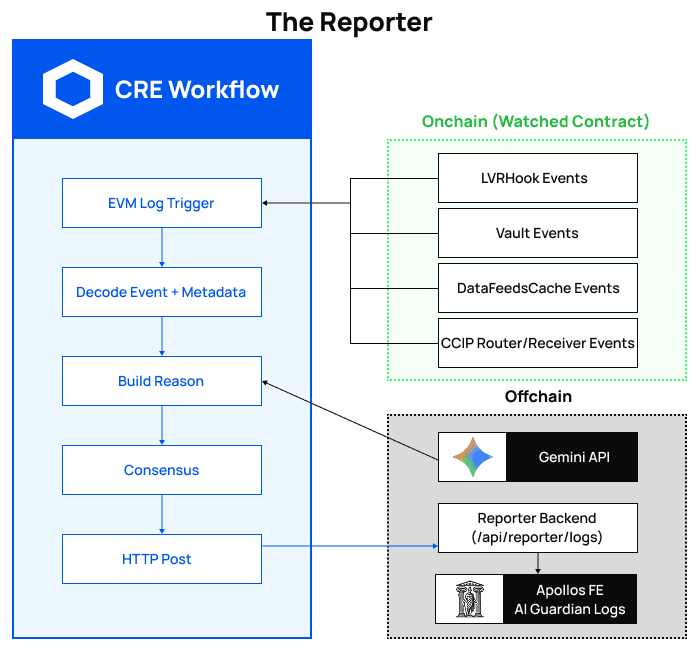
Core feature: Activity logs and AI-readable explanations for users
Template: starter-templates/tokenized-asset-servicing
Problem
DeFi systems often look like black boxes: users cannot see why fees changed or why rebalances happened.
How It Works
- Capture: EVM LogTrigger listens to configured contracts (Vaults, Hook, DataFeedsCache, CCIP contracts).
- Decode: parse event payload and normalize metadata.
- Explain:
- base deterministic reason builder from event type.
- optional Gemini rewrite for user-facing explanation.
- Publish: send normalized JSON via HTTP POST to backend endpoint.
- FE display: logs appear in
AI Guardian Logs.
Value
Machine-decision transparency, higher user trust, and clearer audit trails.
7) The VaR Calculator
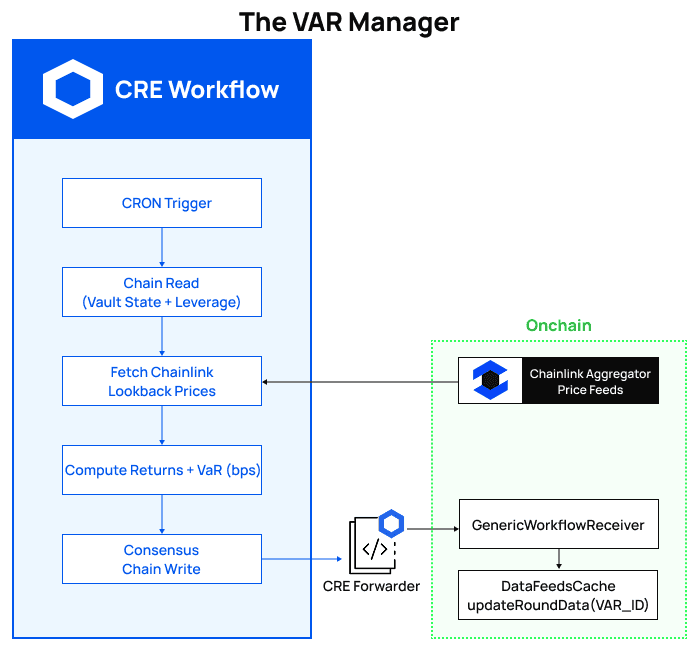
Core feature: Off-chain VaR computation and risk-feed publication
Template: Hybrid
Primary: starter-templates/bring-your-own-data/workflow-ts/nav
Secondary: building-blocks/read-data-feeds
Problem
A leverage vault needs a machine-readable risk signal, not just NAV, to drive monitoring and front-end risk transparency.
How It Works
- Read vault state:
totalAssetsgetCurrentLeverage
- Fetch historical Chainlink rounds (lookback window, configurable).
- Compute returns distribution and
confidenceLevelVaR in bps. - Apply safety floor (
minVarBps) when tail is too flat. - Chainwrite publish:
- Forwarder -> GenericWorkflowReceiver ->
DataFeedsCache.updateRoundData(VAR_ID, bps, updatedAt).
- Forwarder -> GenericWorkflowReceiver ->
Value
Adds quantitative risk telemetry per market (afWETH, afWBTC, afLINK) and enables risk-aware UX.
Simulation and Broadcast (Current)
All workflows are modular and can be simulated independently:
cre workflow simulate workflows/strategist --target=staging-settings --broadcast
cre workflow simulate workflows/auditor --target=staging-settings --broadcast
cre workflow simulate workflows/accountant --target=staging-settings --broadcast
cre workflow simulate workflows/bridge-manager --target=staging-settings --broadcast
cre workflow simulate workflows/var-calculator --target=staging-settings --broadcast
Defender (HTTP trigger):
cre workflow simulate workflows/defender --target=staging-settings --trigger-index 0 --http-payload @workflows/defender/payload.json --non-interactive --broadcastReporter (EVM log trigger):
cre workflow simulate workflows/reporter --target=staging-settings --trigger-index 0 --evm-tx-hash <TX_HASH> --evm-event-index <EVENT_INDEX> --non-interactive --broadcastImplementation Notes
- Chainwrite workflows use a standardized route:
- CRE Workflow -> CRE Forwarder -> GenericWorkflowReceiver -> target contract.
- Reporter is primarily offchain publish (HTTP) and does not require chainwrite for log delivery.
- Chainlink Price Feeds are the baseline oracle reference for market-aware logic.
runtime.now()is used for deterministic timestamping in workflow execution context.